Humira as a Monoclonal Antibody Treatment

Humira, otherwise known as Adalimumab, is a quite popular monoclonal antibody treatment used to treat rheumatoid arthritis, psoriatic arthritis, Crohn’s disease, plaque psoriasis, and ankylosing spondylitis. Monoclonal antibodies derive from the B cells of laboratory animals injected with an antigen. Once the immune response occurs, B cells of the animal are isolated and mixed with myeloma (cancerous cells) which form hybridoma cell fusions. These hybridoma fusions recognize desired anti-X epitopes of a protein while maintaining cellular machinery for producing proliferating and producing antibodies indefinitely. These antibodies can then be given to patients who are unable to target certain proteins for destruction.

Humira specifically works to target tumor necrosis factor alpha (TNF), which is a byproduct of the immune response. In patients with autoimmune diseases such as Crohn’s disease and rheumatoid arthritis, the immune system attacks self cells instead of actual pathogens. In Crohn’s disease inflammation of the digestive tract leads to pain, severe diarrhea, fatigue, and weight loss. Rheumatoid arthritis occurs when joints are targeted by the immune system, leading to pain, inflammation, and destruction of joints. Humira acts to block the effects of TNF through binding it completely. This causes limited destruction of joints and intestines, slowing down the damage of the diseases. This drug therefore negatively regulates an aspect of the innate immune system, inflammation and TNF.

While Humira has benefited thousands nation wide who are afflicted with these various autoimmune diseases, it does pose potential side effects. Mednet lists common side effects such as:

  • headache
  • rash,
  • nausea and upset stomach
  • swelling, pain, and redness
  • itching at site of injection
  • reduced levels of platelets and RBC’s
  • hypersensitivity reactions including anaphylaxis

Additionally, Humira may increase the risk of reactivating HBV in chronic carriers. Since Humira is a TNF blocker, it can lower one’s ability to fight off other infections. The manufacturers therefore state not to take the drug if you have had or currently have TB. It also increases risk for certain types of cancer, including a rare type of cancer called hepatosplenic T-cell lymphoma, since TNF is unable to fight some DAMPS in the body.
Serology Testing in the Wake of Coronavirus

Serology tests have become the thing most people are talking about. Why? Because this is finally people’s pass to go back to work or mandate to stay home, or so they think. Serology tests looks for signs of an immune response by detecting antibodies for a particular pathogen, in this case COVID-19. Some tests are developed for IgM antibodies, IgG antibodies, IgA antibodies, or all three. These tests are not created equal, however, because the detection of IgM antibodies only means a partial activation of B cells by the virus, meaning a full infection may not have taken place to give someone full immunity. IgG and IgA antibodies are created later after a B cell is fully activated during a full blown infection. As IgG antibodies rise, IgM antibodies lower. IgA antibodies, present in mucosal tissues such as the inner lining of the lung, are known to be important for fighting respiratory infections such as influenza, and are likely to be central in coronavirus infection, too.

Even if a person is found to have higher grade antibodies, such as IgG or IgA, this does not necessarily mean they are ready to return to work. Immunity lies on a spectrum, and while some diseases, such as varicella-zoster, provide full lifelong immunity after infection, others, such as Clostridium tetani, offer no protection. Even routine vaccinations for tetanus require continuous booster shots. Research on COVID-19 is still in its very early stages, and knowledge about where SARS-CoV-2 lies on the immunity spectrum is minimal to none. While the coronavirus seems to be producing antibodies, we simply don’t know what it takes to be effectively protected.

Researchers are struggling to answer these major questions of this virus. How long do COVID-19 antibodies remain in the body? Do they protect against reinfection? These uncertainties hang in the balance while the nations wait. This waiting time is vital, however, and jumping back into work before the allocated time will end in further infection and death.

Finding a Cure

For most, the diagnosis of any type of cancer often feels like an extreme and crushing blow. While multitudes of treatments are available, many of which can produce amazing results, there is still no curing drug that works as a 100% panacea for all cases. The search for a cure to the second leading cause of death in America (only slightly behind heart disease) has been widely sought out and meticulously studied. There is one possible solution that has garnered much support and hope over the past few years. The use of dendritic cells in cancer therapy provides a glimmering hope that disentangles the main problem of cancer: the body’s evasion of the immune system.

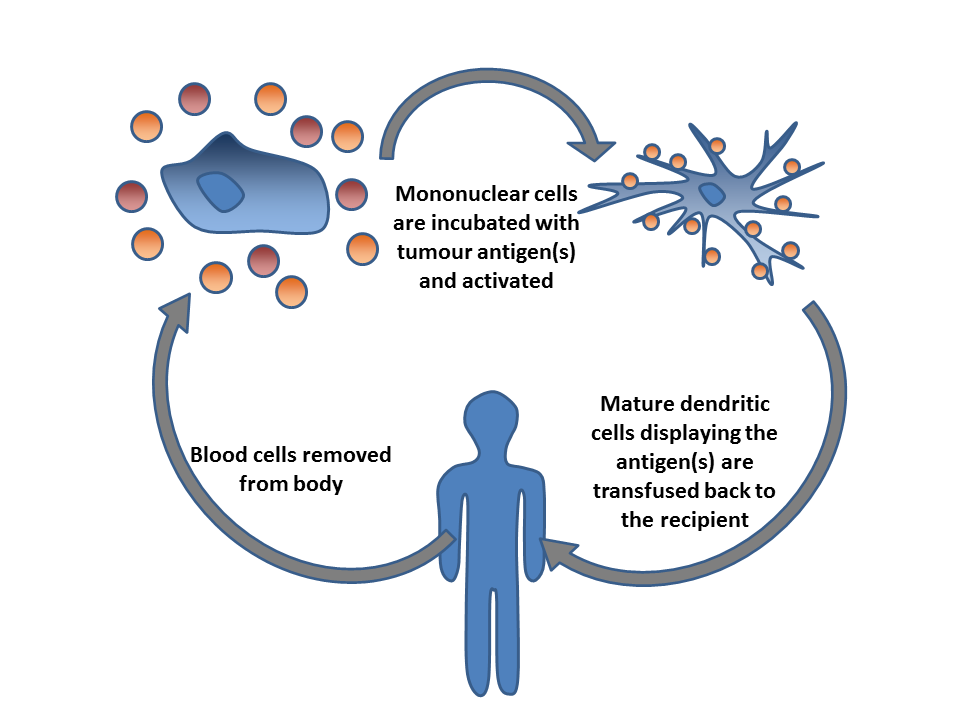
Dendritic cells are the spies of the body, recognizing and tagging abnormal cells and pathogens to bring to cytotoxic T cells, thereby activating the body to fight these dangerous growths. Cancer, however has many sneaky ways of evading the immune system and convincing dendritic cells that they are normal “self” cells. Dendritic cell therapy is a personalized therapy that removes blood cells from the body, incubates them with patient’s specific tumor antigens for activation, and releases the mature antigen presenting dendritic cells back into the body intravenously to mount an immune response. The therapy is non-invasive, produces no long lasting side effects as with chemotherapy, and uses the body’s natural healing system to rid itself of the damaged cells. Numerous studies and trials exploring the possibilities of therapeutic autologous dendritic cells have been undertaken and sponsored by the National Cancer Institute.

File:Dendritic cell therapy.png - Wikimedia Commons
Figure taken from https://amberlifeclinic.eu/dendritic-cell-therapy/

DCV (dendritic cell vaccine therapy) has shown very promising results, revealing a two to three times higher survival rate in DCV patients than in control patients, even when combined with chemotherapy. DCV can be used to treat a plethora of cancer varieties including breast cancer, brain cancer, stomach cancer, uterine cancer, colon cancer, melanoma, kidney cancer, liver cancer, sarcoma, and others. It can also offer solutions at various stages of the disease and has been shown to limit the aggressiveness of particularly virulent cancers. DCV has elicited much excitement in the scientific community as a targeted therapy which trains a patient’s own cells against each patient’s specific cancer. While we are still a ways off from proclaiming a complete cure, DCV is a promising solution that could be a step in that direction.

Until Tomorrow…

To be honest, when I first heard that UNC would be practicing “social distancing” by having their students take classes from home, I was pretty excited. The opportunity to stay home with family while taking classes seemed like an enticing break from the everyday routine. However, as the situation grew worse and as I read more about the COVID-19 crisis, I realized how much on lock-down we really had to be. This would not only be social distancing from those in Chapel Hill, but from friends, restaurants, stores, and the community. In order to keep this virus from spreading and protect the most vulnerable, everyone must remain on alert and away from the community in which they’ve grown so accustom to living.

I am by nature a very social person. I love residing in public areas among people, festivities, families, animals and the like. I enjoy spending time with friends as well as being outside in nature. I am very grateful that we still have the ability to go outside and exercise, though social interaction has been very limited. It has felt very isolating having to stay away from people, friends, and the community. It has only been about two weeks since isolation began, and the thought that this might continue well into the summer is a bit disheartening. It has additionally thrown many everyday events into upheaval, such as income, summer plans, and classes.

I want to be Where the People Are - Misc - quickmeme

In the midst of the upheaval, however, I am very grateful for my amazing professors who have provided much support during this time and worked their hardest to maintain the best possible education. Zoom classes have worked very well this week and brought some sense of normalcy back to everyday life. I have felt very engaged in class, though it definitely has been an adjustment learning to work completely in my bedroom and maintain the discipline to get up and do work even though I am not going to campus. The virtual support and community that I have felt from friends and students online has given me hope, warmth, and inspiration that we will make it through this difficult time of isolation. I definitely miss Carolina, the people, and the campus (especially in the spring), and am looking forward to returning hopefully by the summer.

Bacteria Game Changers

Gonorrhea is one of the most common STD’s in the nation, and steadily rising. In just four years, from 2014 to 2018, rates of gonorrhea rose by a startling 63% according to a national report from the Centers for Disease Control. Doctors are ambiguous about the exact reasoning for the spike in cases, but it is likely due to several factors. Recent decades have allowed new medical improvements to birth control options. In addition to new methods of birth control, development of medications to prevent HIV have made it much easier for people to dismiss the use of condoms without fear of pregnancy or HIV. As use of condoms have declined, gonorrhea rates have naturally sky-rocketed.

the intern discussion GIF

With an increase in cases (50% of which are asymptomatic, furthering the risk of unknown transmission), mutation and antibiotic resistance are also steadily rising. Gonorrhea bacteria have quickly developed resistance to nearly every antibiotic used to kill them. Cephalosporins are the only class of drugs left that are still largely effective, and gonorrhea is beginning to show resistance to that as well. Antibiotic resistance studies have revealed the bacteria to present a new peculiar behavior: hiding out in the body to avoid detection. They do this by infecting a person’s throat. “Research is starting to show that gonorrhea in the throat is more common that we think. Work from a group in Australia suggests that gonorrhea may be passed through kissing only, though it’s probably rare,” says Dr. Lindley Barbee, an infectious disease specialist and medical director.

As gonorrhea is finding new ways to yield resistance to our treatments, it is effectively changing the game for doctors and forcing scientists to quickly pursue new modes of attack to win the fight. While a few promising new antibiotics are on the horizon, they likely won’t be open for public treatment for several more years. One of the new drugs, solithromycin, has completed its last phase of clinical trials, and two other news drugs, zoliflodacin and gepotidacin, revealed promising results in their phase 2 trials. It is critical to continuously monitor antibiotic resistance in this bacteria and encourage research and development of new treatment regimens. Otherwise, increasing resistance to the current treatment could result in a rise in complications associated with gonorrhea infections. These complications, which predominantly affect women, include infertility, pelvic inflammatory disease, and ectopic pregnancy.

Back to the 1800’s: A Future World without Antibiotics?

Antibiotics have revolutionized the medical field in the 20th century from their first insurgence in 1929. Penicillin, the first discovered antibiotic, was developed by Alexander Fleming from the fungus Penicillium. Since their early years, antibiotics have been developed for hundreds of bacteria infections and used recurrently for millions of patients. While at their beginning, antibiotics were developed faster than bacteria were developing resistance for them, new resistance has threatened the use of many antibiotics. As resistance grows, it causes appropriate worry if society will soon be forced to face today’s diseases without antibiotics.

A “superbug” is a term coined to describe a certain strain of bacteria that has become resistant to many of the main antibiotics used to treat that disease. Resistance can arise from conjugation of bacteria using sex pili, or from lysogenic transformation of R plasmids. The most recent drug resistant microbes Candida auris and Acinetobacter. These microbes have been deemed “urgent threats” to American health as more and more microbes are acquiring their resistance. A previous report, published in 2013, estimated that at least 2 million people in the US get an antibiotic-resistant infection each year and that at least 23,000 people die from these infections. Today, drug-resistant bacteria and fungi cause more than 2.8 million infections and 35,000 deaths across the country annually, revealing the steep increse.

Antibiotic resistance is a naturally occurring event that can be slowed, but not stopped. However, certain practices can perpetuate the rapid spread of disease resistance. Poor infection control practices, misuse of antibiotics, and mishandling food are some of the main ways resistance is spread. We as a medical community can help tackle antibiotic resistance by using antibiotics as directed and only when needed, completing full treatment courses, never using leftover prescriptions, and never sharing antibiotics. Antibiotic resistance is one of the scariest things society is currently facing, after global warming. It is absolutely vital that we begin taking measures to protect ourselves and our future generations from reverting to 1800’s level medical care.

OPV and IPV: Our Only Weapons Against the World’s Deadly Poliovirus

Polio, or poliomyelitis, is a crippling and deadly disease caused by the poliovirus.
The virus, which spreads through fecal-oral contact, lives in an infected person’s throat and intestines where it can cause paresthesia (feeling of pins and needles in the legs), meningitis, and paralysis. This disease is very scary, as it often leaves effects on the patient that last for the rest of their lives, and even those that do recover fully can develop post-polio syndrome later in life. However, because this virus’ only reservoir is humans, there is hope at eradicating this virus forever if everyone receives the polio vaccine. This seems like a no-brainer to me, as the effects of polio are still being felt very strongly around the world, and could be eliminated very efficiently by a simple vaccine.

There are two main types of vaccines used to protect against the polio virus: the IPV and OPV. The IPV, or inactivated poliovirus vaccine, is an inactivated form of the virus that is injected into a patient’s leg or arm in four separate doses. This vaccine has been utilized in the US since 2000 and provides 99% immunity to the virus. The OPV, or oral poliovirus vaccine is administered orally by receiving drops of the vaccine in the mouth, since that is where the virus enters and lives. Since 2000 however, only IPV has been used in the United States to eliminate the risk of vaccine-derived poliovirus that can occur with OPV. This decision was also based on the decreased risk of poliovirus being brought into the country and because the US is currently polio-free, however the OPV is still used in other parts of the world.

In December of last year, the Center for Infectious Disease Research and Policy (CIDRAP) announced an outbreak in six nations, including Pakistan which reported 91 cases in 2019 (a stark increase from 12 cases in 2018). The outbreaks have emerged as five new wild type 1 (WPV1) cases and two more circulating vaccine-derives poliovirus type 2 (cVDPV2) cases have been reported. The virus, which flies under the radar for many first-world, unaffected countries, is still very much a global public health concern according to the WHO. The virus continues to mutate as it circulates, making it even more vital that as many people as possible are vaccinated to prevent not only its spread but also its evolution. The more people that we can reach with these vaccinations, the greater the chance that we can one day rid the world of polio.

Microbiome’s Unexpected Effects on Dieting

Have you ever been on a diet with someone who just seemed to always beat you in the weight loss game even though you ate and exercised the same amount? Now especially, after the holiday months, many people attempt to lose weight only to give up after a few months of high effort and low payoff. It is the plight of many to see other’s work rewarded while there own efforts go seemingly forgotten. However, a recent story shared by NPR has shed new light on the role that the millions of bacteria living in our bodies, known as the microbiome, has on dieting. This finding has major implications on the future of dieting.

Image result for can't lose weight gif

NPR describes a study lead by Purna Kashyap, a gastroenterologist at the Mayo Clinic, in which people who were enrolled in a lifestyle-intervention program for weight loss were tracked for both weight loss and gut bacteria. The participants were advised to follow a low-calorie diet, and followed closely for about three months. “We found that people who lost at least 5 percent of their body weight had a vastly different gut bacteria as compared to those who did not lose 5 percent of their body weight,” Kashyap explained in a published Mayo Clinic journal. The successful dieters had an increased abundance of a bacteria called Phascolarctobacterium, whereas another bacteria, Dialister, was increased in those who were unsuccessful in their weight loss efforts. It was hypothesized that there were likely other bacteria who were also culprits in effecting the weight loss of some over others.

This major effect that gut bacteria has on weight loss can be explained when we think about the way the body digests much of its food. We as humans are reliant on many bacteria to break down the food that we cannot digest or absorb ourselves. The more efficient the bacteria is at digesting food into forms that we can absorb, the more calories we obtain from the food that we eat. The new study suggests that certain bacteria may be more efficient at creating these “extra” calories for us to digest. While its not simple for scientists to manipulate the mix of microbes in our guts, identifying the organisms that are thought to be beneficial in weight loss or gain can become monumental as new drugs are created to target the weight loss or gain of the body.

Coronavirus (RUNNNNN)

Coronavirus has officially been declared a Pandemic (insert Dr. Cramer flag wave here). A Feb 2nd New York Times article declared about 14,000 lab-confirmed cases in over 23 countries, soaring dramatically from the initial 50 cases in Wuhan, China. There have been over 300 deaths, and epidemiological models estimate that the real number of cases is around 100,000 and maybe even more. Compared to the 2003 SARS or 2012 MERS outbreak, coronavirus has taken an enormous leap in expansion, though still not quite as rapid as the flu or measles. Though the virus is known to be spreading quickly among humans, scientists do not yet know how lethal the new coronavirus is, so there is uncertainty about how much damage a pandemic might cause.

Coronaviruses are a large family of viruses that are common in many different species of animals, including camels, cattle, cats, and bats. These animal viruses rarely infect people, however outbreaks of the novel coronavirus have made the leap. The virus is thought to have started in Chinese wet markets, where living and dead animals are hung in constant close contact, making it very easy for a virus to jump from an animal to a human. On January 22, authorities in Wuhan, China banned the trade of live animals at wet markets as questions regarding the health risks of these markets continued to rise. The specific market where the outbreak might have begun, the Huanan Wholesale Seafood Market, was shut down on January 1.

The United States reported the first confirmed instance of person-to-person spread with this virus on January 30, 2020 and on that same day, the International Health Regulations Emergency Committee of the World Health Organization declared the outbreak a “public health emergency of international concern.” Investors have rushed to biotechs working on a coronavirus vaccine. At least a dozen companies have informally or formally announced vaccine or drug development initiatives, and some programs will move into clinical testing within a few months. Some of these programs include drugs already approved for other viral infections, unapproved drugs for other viruses, and new monoclonal antibody vaccines. It is the hope of many scientists that new tech might allow a vaccine in record time, helping to alleviate the rapid global spread of the virus.

In the Wake of Wakefield

Well, 12 years later in 2010, the Lancet journal FINALLY retracted its 1998 Andrew Wakefield article that falsified facts linking the measles, mumps, and rubella (MMR) vaccine to autism in children.

About damn time

In a statement published on Feb. 2, the British medical journal clearly stated that “several elements” of the 1998 paper published by Dr. Andrew Wakefield and his colleagues “are incorrect, contrary to the findings of an earlier investigation.” Wakefield and 12 coauthors claimed to have investigated a series of 12 randomized children referred to the Royal Free Hospital and School of Medicine for chronic enterocolitis and regressive developmental disorder. The article connected the symptoms of autism to the children’s recent MMR vaccine, stating that 8 of the 12 parents noticed loss of acquired skills directly after having vaccinated their child. When the article was first released, it spread quickly throughout the media and was soon followed up by various speeches and interviews in which Wakefield claimed that the combination of the MMR vaccine posed danger for its recipients.

However, in January of 2010, Britain’s General Medical Council ruled that the children in Wakefield’s study were not at all randomized, but that they were carefully selected to fit within the framework of the message Wakefield was trying to present. What’s more, it was soon established that Wakefield had been funded by lawyers acting for parents who were involved in lawsuits against vaccine manufacturers, giving him a clear alternative motive for falsifying data. Millions of dollars consequently went into various further investigations and studies to determine the safety of the MMR vaccine and the falsification of Wakefield’s study. It was Deer’s 2004 paper that unearthed the potential research fraud, unethical treatment of children, and conflict of interest that Wakefield’s study presented. It was soon revealed that Wakefield took advantage of vulnerable families who were looking for an explanation to their child’s condition to sell his own agenda.

While various other scientific articles and studies have been since performed to expose Wakefield’s false data conclusion, it has still caused great harm to the community and to patients who refuse to be vaccinated. In the United Kingdom, the Health Protection Agency attributed a large measles outbreak in 2008 and 2009 to a large drop in the number of children receiving the MMR vaccine. Cases of measles have also continued to rise in the US and Canada as anti-vaccination propaganda rises.

In the United Kingdom, the Health Protection Agency attributed a large measles outbreak in 2008 and 2009 to a large drop in the number of children receiving the MMR vaccine

Scientists who publish their research have an ethical responsibility to ensure the highest quality of research protocols, data analysis, and reporting. There can be no compromising in science, because, as the Wakefield saga so aptly reveals, any deficit in the scientific method cause cause great harm to patients, the community, and science.